Van de week plaatste ik Josephs story n.a.v. zijn nier transplantatie (aug 2015) Twee jaar eerder werd dit stukje geplaatst, mooi om te zien dat er door de jaren heen nieuwe kansen zijn ontstaan voor hem en zijn gezinnetje.
Update: Thembalethu carpenter's dream
05:00 (GMT+2), Thu, 12 September 2013
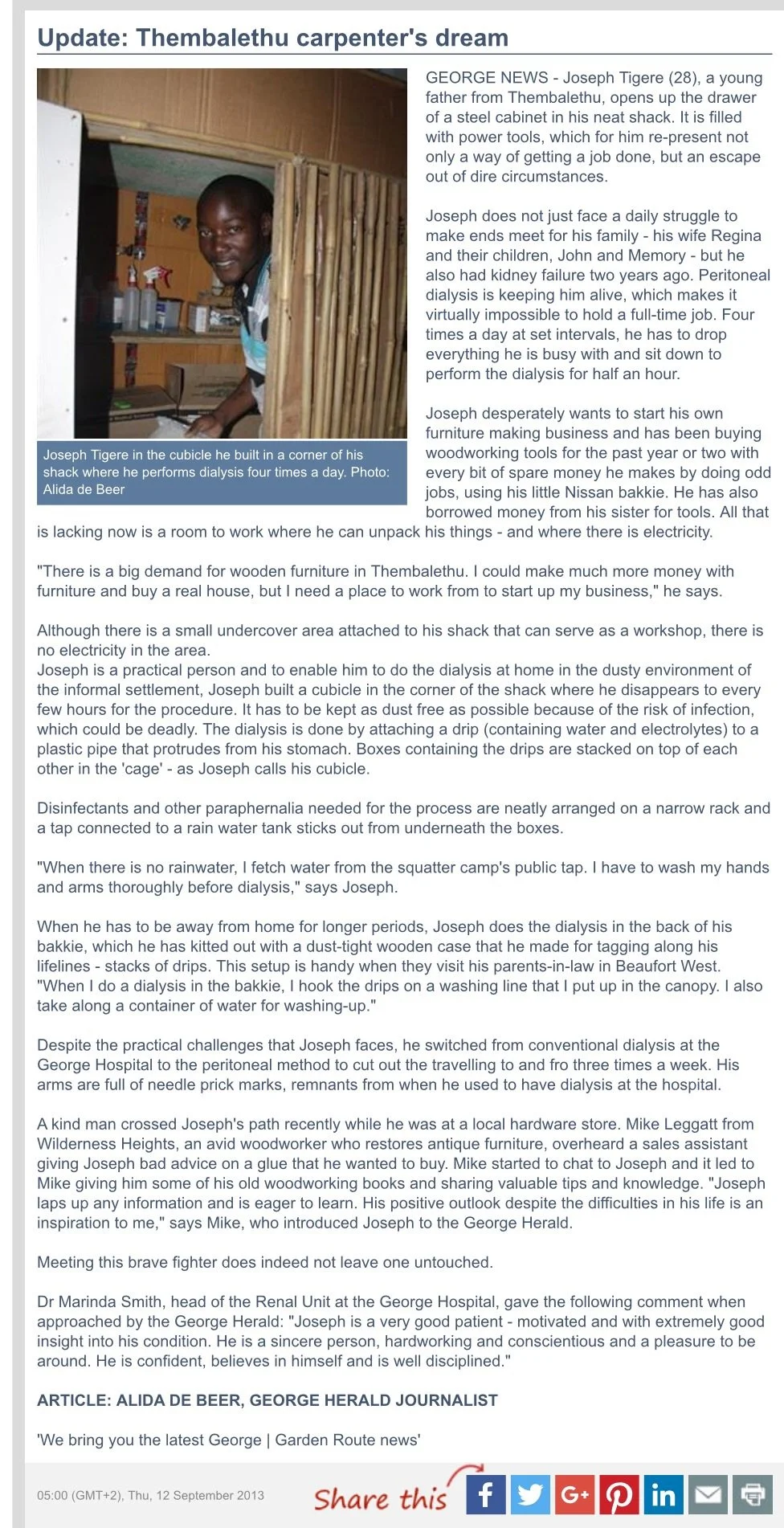
Joseph Tigere in the cubicle he built in a corner of his shack where he performs dialysis four times a day. Photo: Alida de Beer
GEORGE NEWS - Joseph Tigere (28), a young father from Thembalethu, opens up the drawer of a steel cabinet in his neat shack. It is filled with power tools, which for him re-present not only a way of getting a job done, but an escape out of dire circumstances.
Joseph does not just face a daily struggle to make ends meet for his family - his wife Regina and their children, John and Memory - but he also had kidney failure two years ago. Peritoneal dialysis is keeping him alive, which makes it virtually impossible to hold a full-time job. Four times a day at set intervals, he has to drop everything he is busy with and sit down to perform the dialysis for half an hour.
Joseph desperately wants to start his own furniture making business and has been buying woodworking tools for the past year or two with every bit of spare money he makes by doing odd jobs, using his little Nissan bakkie. He has also borrowed money from his sister for tools. All that is lacking now is a room to work where he can unpack his things - and where there is electricity.
"There is a big demand for wooden furniture in Thembalethu. I could make much more money with furniture and buy a real house, but I need a place to work from to start up my business," he says.
Although there is a small undercover area attached to his shack that can serve as a workshop, there is no electricity in the area.
Joseph is a practical person and to enable him to do the dialysis at home in the dusty environment of the informal settlement, Joseph built a cubicle in the corner of the shack where he disappears to every few hours for the procedure. It has to be kept as dust free as possible because of the risk of infection, which could be deadly. The dialysis is done by attaching a drip (containing water and electrolytes) to a plastic pipe that protrudes from his stomach. Boxes containing the drips are stacked on top of each other in the 'cage' - as Joseph calls his cubicle.
Disinfectants and other paraphernalia needed for the process are neatly arranged on a narrow rack and a tap connected to a rain water tank sticks out from underneath the boxes.
"When there is no rainwater, I fetch water from the squatter camp's public tap. I have to wash my hands and arms thoroughly before dialysis," says Joseph.
When he has to be away from home for longer periods, Joseph does the dialysis in the back of his bakkie, which he has kitted out with a dust-tight wooden case that he made for tagging along his lifelines - stacks of drips. This setup is handy when they visit his parents-in-law in Beaufort West. "When I do a dialysis in the bakkie, I hook the drips on a washing line that I put up in the canopy. I also take along a container of water for washing-up."
Despite the practical challenges that Joseph faces, he switched from conventional dialysis at the George Hospital to the peritoneal method to cut out the travelling to and fro three times a week. His arms are full of needle prick marks, remnants from when he used to have dialysis at the hospital.
A kind man crossed Joseph's path recently while he was at a local hardware store. Mike Leggatt from Wilderness Heights, an avid woodworker who restores antique furniture, overheard a sales assistant giving Joseph bad advice on a glue that he wanted to buy. Mike started to chat to Joseph and it led to Mike giving him some of his old woodworking books and sharing valuable tips and knowledge. "Joseph laps up any information and is eager to learn. His positive outlook despite the difficulties in his life is an inspiration to me," says Mike, who introduced Joseph to the George Herald.
Meeting this brave fighter does indeed not leave one untouched.
Dr Marinda Smith, head of the Renal Unit at the George Hospital, gave the following comment when approached by the George Herald: "Joseph is a very good patient - motivated and with extremely good insight into his condition. He is a sincere person, hardworking and conscientious and a pleasure to be around. He is confident, believes in himself and is well disciplined."
ARTICLE: ALIDA DE BEER, GEORGE HERALD JOURNALIST